
The STOXX Europe 600 is a major stock index in Europe. It tracks 600 companies from 17 countries, including Germany, France, the UK, Spain, and Switzerland. The index shows how European markets are performing and includes large, mid, and small-cap stocks.
Investors use it to understand market trends and compare with other global indices like the S&P 500 or DAX. FintechZoom.com makes following the STOXX 600 simple. The platform provides real-time quotes, charts, sector breakdowns, and news updates.
Beginners and experienced investors can use it to track trends, analyze sectors, and make informed investment decisions. It is a helpful tool for anyone interested in European stocks and market performance.
What Is the STOXX 600?
The STOXX Europe 600 is a major European stock market index. It includes companies of large, mid, and small-cap sizes. The 600 companies come from 17 developed European countries such as Germany, France, the United Kingdom, Spain, and Switzerland.
This index is designed to represent about 90% of Europe’s free-float market capitalization, making it a reliable benchmark. It is part of the broader STOXX 1800 family, which links European stocks with U.S. and Asia-Pacific markets.
Investors use the STOXX 600 to:
- Measure overall European market performance
- Compare European stocks with other indices like S&P 500 or DAX
- Understand diversification across countries and sectors
The index allows investors to track not only the biggest companies but also smaller firms that may have high growth potential. This makes the STOXX 600 a comprehensive tool for investment analysis.
Key Features and Sector Coverage
The STOXX 600 is highly diversified across sectors and countries. It covers both well-known blue-chip companies and growing firms.
Key Features
- Diversification: Covers 600 companies across multiple countries.
- Sector Coverage: Offers exposure to all major European industries.
- Benchmarking: Used as a reference for mutual funds and ETFs.
Sector Coverage
The STOXX 600 includes:
- Health Care: Novo Nordisk, AstraZeneca
- Technology: ASML, SAP
- Financials: HSBC, Allianz
- Consumer Goods: Nestlé, LVMH
- Industrials: Siemens, Airbus
- Energy: TotalEnergies, Shell
- Utilities: Iberdrola, Enel
- Real Estate: Unibail-Rodamco
Table: STOXX 600 Sector Breakdown
| Sector | Example Companies | Weight Approx. |
| Health Care | Novo Nordisk, AstraZeneca | 15% |
| Technology | ASML, SAP | 14% |
| Financials | HSBC, Allianz | 12% |
| Consumer Goods | Nestlé, LVMH | 10% |
| Industrials | Siemens, Airbus | 9% |
| Energy | TotalEnergies, Shell | 8% |
| Utilities | Iberdrola, Enel | 5% |
| Real Estate | Unibail-Rodamco | 3% |
The sector coverage allows investors to focus on industries of interest. ETFs and derivatives often track these sectors separately, providing flexibility.
Historical Performance and Volatility
The STOXX 600 was created in the late 1980s. Since then, it has experienced bull and bear markets. Historically, the index has shown positive returns in around 70% of calendar years.
Major events like the 2008 financial crisis and the 2020 pandemic caused significant drawdowns. On the other hand, periods of economic growth have led to record highs. Sectors such as healthcare, technology, and luxury goods have often led the gains.
Volatility in the STOXX 600 can be caused by:
- Central bank policies such as ECB interest rate changes
- Energy price fluctuations
- Geopolitical tensions
- Global trade developments
Despite risks, the STOXX 600 remains a solid benchmark for long-term investors.
How FintechZoom Covers STOXX 600
FintechZoom.com provides tools to make STOXX 600 analysis simple and accessible.
- Real-time quotes: Stay updated with the latest prices.
- Interactive charts: Analyze trends over different timeframes.
- Technical indicators: Includes RSI, moving averages, and more.
- Sector breakdowns: Identify strong and weak sectors quickly.
- News and analysis: Understand market drivers and global events.
Using FintechZoom, investors can compare the STOXX 600 with other indices, track ETFs, or monitor sector performance. The platform is suitable for both beginners and experienced traders.
Why STOXX 600 Matters for Investors
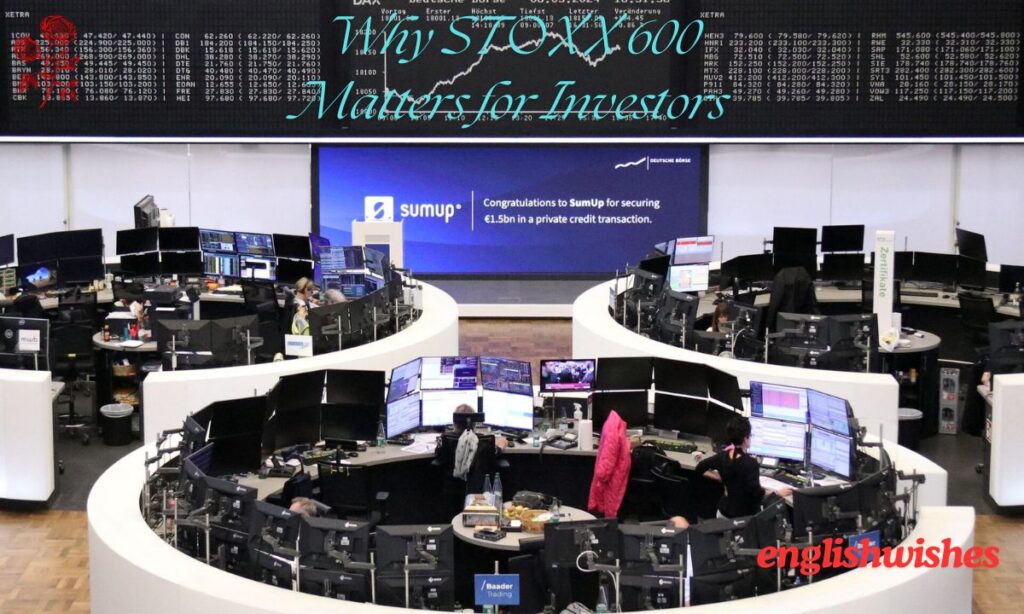
The STOXX 600 is more than just an index—it is a tool for investment decision-making.
- Market Benchmark: Fund managers and ETFs use it as a reference.
- Diversification: Exposure to strong European sectors.
- Accessibility: Low-cost ETFs allow investors to buy the entire index easily.
Investors gain exposure to industries like luxury goods, pharmaceuticals, and industrial automation. The STOXX 600 also helps international investors diversify outside the U.S. markets.
Trading STOXX 600: ETFs, Futures, and Options
Investors can access the STOXX 600 through multiple instruments.
- ETFs: Track the index directly. Some are currency-hedged or ESG-focused.
- Futures: Standardized contracts for tactical trading or hedging.
- Options: For leveraged or hedging strategies.
Eurex offers futures and options on both the main index and its sector sub-indices. This allows investors to create risk management or relative-value strategies.
- ETFs are ideal for long-term, passive investors.
- Futures are for short-term, tactical traders.
- Options provide flexibility for risk management.
Factors That Move the STOXX 600
The index reacts to several factors, both domestic and global.
- Corporate earnings: Positive results drive stock prices higher.
- Economic data: GDP growth, inflation, and employment reports influence the market.
- Central bank policies: ECB decisions affect liquidity and interest rates.
- Global events: Geopolitics, trade wars, and energy prices impact the index.
European companies earn revenue worldwide. Therefore, U.S., China, and emerging markets growth also affects STOXX 600 performance.
Using FintechZoom to Analyze STOXX 600
FintechZoom allows investors to perform full workflow analysis, from research to trading.
- Chart timeframes: Intraday to multi-year
- Technical overlays: RSI, MACD, moving averages
- Index comparison: Compare STOXX 600 with DAX, FTSE 100, or S&P 500
- Articles and research: Themes like ESG flows, sector rotation, and macro trends
- ETF screeners and derivatives data: Help with execution and portfolio planning
These features allow investors to make informed trading and investment decisions.
Risks and Limitations of STOXX 600 Investing
Even though it is diversified, there are risks.
- Political and regulatory: Brexit, eurozone debt issues, government policies
- Currency fluctuations: EUR/USD or other currencies can impact returns
- Sector risk: Banks or autos may dominate returns, affecting balance
- Global macro shocks: Pandemics, trade wars, and energy crises
Investors should align STOXX 600 exposure with their risk tolerance, investment horizon, and portfolio goals.
Frequently Asked Questions
What does the STOXX 600 track?
It tracks 600 large, mid, and small-cap companies from 17 European countries.
How does FintechZoom help STOXX 600 investors?
It provides real-time quotes, charts, technical indicators, and news analysis.
Can beginners use FintechZoom’s STOXX 600 tools?
Yes, the platform is user-friendly with clear charts and simple navigation.
What are common ways to invest in STOXX 600?
Investors can use ETFs, mutual funds, futures, and options.
What risks should I consider with STOXX 600?
Key risks include political, currency, sector, and global macro risks.
Conclusion
The STOXX Europe 600 is a cornerstone of European equities. It represents 600 companies across 17 countries, covering most of the investable market. FintechZoom.com enhances this index with real-time data, charts, sector insights, and news updates.
Investors can access the index through ETFs for broad exposure or futures and options for tactical strategies. Understanding drivers, risks, and market tools helps investors make smarter decisions.

Muhammad Shoaib is a passionate content creator with 3 years of experience in Love Shayari, Sad Shayari, Birthday Shayari. He crafts engaging, heartfelt content for readers and currently contributes his expertise to Englishwishes.com, delivering inspiring and memorable shayari and blog posts for a wide audience.