Indoor games bring joy and entertainment right into our homes. These games are perfect for all ages and weather conditions. They help us stay active and engaged without stepping outside. Indoor games create memorable moments with family and friends.
Playing games indoors offers countless benefits for everyone. Children develop essential skills through playful activities. Adults find stress relief and mental stimulation. Indoor games strengthen bonds between people of all generations.
The variety of indoor games available today is truly impressive. From traditional board games to modern activities, there’s something for everyone. These games require minimal space and equipment. They transform any room into a fun-filled entertainment zone.
What are Indoor Games?
Indoor games are activities played inside enclosed spaces like homes, schools, or community centers. These games don’t require outdoor facilities or large open areas. They can be enjoyed regardless of weather conditions or time of day. Indoor games include physical activities, mental challenges, and creative pursuits.
The beauty of indoor games lies in their accessibility and convenience. Most indoor games need simple equipment that’s easy to store. They’re perfect for rainy days, cold winters, or hot summers. Indoor games bring people together in comfortable, controlled environments.
Indoor games differ from outdoor sports in several important ways. They typically involve smaller playing areas and fewer participants. The rules are often simpler and easier to learn quickly. Safety concerns are minimal since players remain in protected spaces. Indoor games adapt well to different age groups and skill levels.
List of Common Indoor Games in English
Indoor games come in many exciting forms and categories. Each game offers unique entertainment and learning opportunities. Here’s a comprehensive look at popular indoor games played worldwide.
Board Games: These classic games use boards, cards, or pieces for gameplay. Chess challenges strategic thinking and planning skills. Checkers offers simple yet engaging competitive play. Monopoly teaches money management and negotiation. Scrabble builds vocabulary and spelling abilities. Ludo provides family-friendly dice-rolling fun.
Card Games: Playing cards create endless entertainment possibilities for all ages. Poker tests probability skills and psychology. Rummy develops pattern recognition and memory. Uno brings colorful fast-paced action to any gathering. Solitaire offers solitary entertainment and patience building. Bridge requires partnership and complex strategy.
Table Games: These games require special equipment and playing surfaces. Table tennis improves reflexes and hand-eye coordination. Carrom board develops precision and finger control. Foosball creates exciting competitive matches. Air hockey delivers fast-paced action and quick thinking. Pool teaches geometry and angle calculation.
Physical Indoor Games: Active games get bodies moving without going outside. Hide and seek encourages creativity and problem-solving. Musical chairs combines music with quick reactions. Pillow fights provide safe physical release and laughter. Indoor bowling adapts outdoor sports for inside play. Balloon volleyball offers gentle exercise and fun.
Puzzle Games: Mental challenges that stimulate cognitive abilities effectively. Jigsaw puzzles improve spatial awareness and patience. Rubik’s cube develops problem-solving and persistence. Sudoku sharpens logic and number skills. Crossword puzzles expand vocabulary and general knowledge. Word searches enhance pattern recognition abilities.
Popular Indoor Games Table
| Game Name | Players | Equipment Needed | Skill Level |
| Chess | 2 | Chessboard, pieces | Advanced |
| Ludo | 2-4 | Board, dice, tokens | Beginner |
| Carrom | 2-4 | Board, striker, coins | Intermediate |
| Uno | 2-10 | Card deck | Beginner |
| Scrabble | 2-4 | Board, letter tiles | Intermediate |
| Table Tennis | 2-4 | Table, paddles, ball | Intermediate |
| Jenga | 2-8 | Wooden blocks | Beginner |
| Monopoly | 2-8 | Board, money, pieces | Intermediate |
Why Indoor Games are Good?
Indoor games provide tremendous benefits for physical health and wellness. They keep bodies active even during bad weather conditions. Many indoor games improve coordination and motor skills significantly. Physical indoor activities burn calories and maintain fitness levels. Regular play strengthens muscles and increases flexibility naturally.
Mental development receives powerful boosts from indoor gaming activities. Problem-solving skills improve through strategic game planning. Memory enhancement occurs during card and board games. Concentration abilities grow stronger with focused gameplay. Critical thinking develops when players make important decisions. Creativity flourishes in imaginative indoor game scenarios.
Social skills blossom beautifully through indoor game interactions. Players learn cooperation and teamwork during group activities. Communication skills improve through game discussions and negotiations. Sportsmanship develops when accepting wins and losses gracefully. Friendships deepen through shared gaming experiences and laughter. Family bonds strengthen during quality indoor game time together.
Key Benefits of Indoor Games:
- Stress Relief: Games provide mental breaks from daily pressures and worries
- Weather Independence: Play anytime without weather-related interruptions or cancellations
- Safety: Controlled environments reduce injury risks and dangerous situations
- Affordability: Most games require minimal investment and reusable equipment
- Flexibility: Adapt rules easily to suit different ages and abilities
- Learning: Develop various skills while having genuine fun
- Bonding: Create lasting memories with loved ones indoors
- Accessibility: Suitable for people with different physical capabilities
Educational benefits make indoor games valuable learning tools always. Mathematics skills improve through scoring and counting activities. Language development accelerates with word-based games naturally. Strategic thinking grows through planning and decision-making processes. Pattern recognition strengthens with puzzle and matching games. Historical knowledge expands through themed board game content.
Emotional well-being improves significantly through regular indoor gameplay. Self-confidence builds when mastering new game skills successfully. Patience develops while waiting for turns patiently. Emotional regulation improves when managing competitive feelings appropriately. Joy and happiness increase during fun-filled gaming sessions. Stress hormones decrease during engaging recreational activities consistently.
Also Read This English Blog: 81 Affirmative Sentences List 2026
Indoor Games Name with Their Pictures
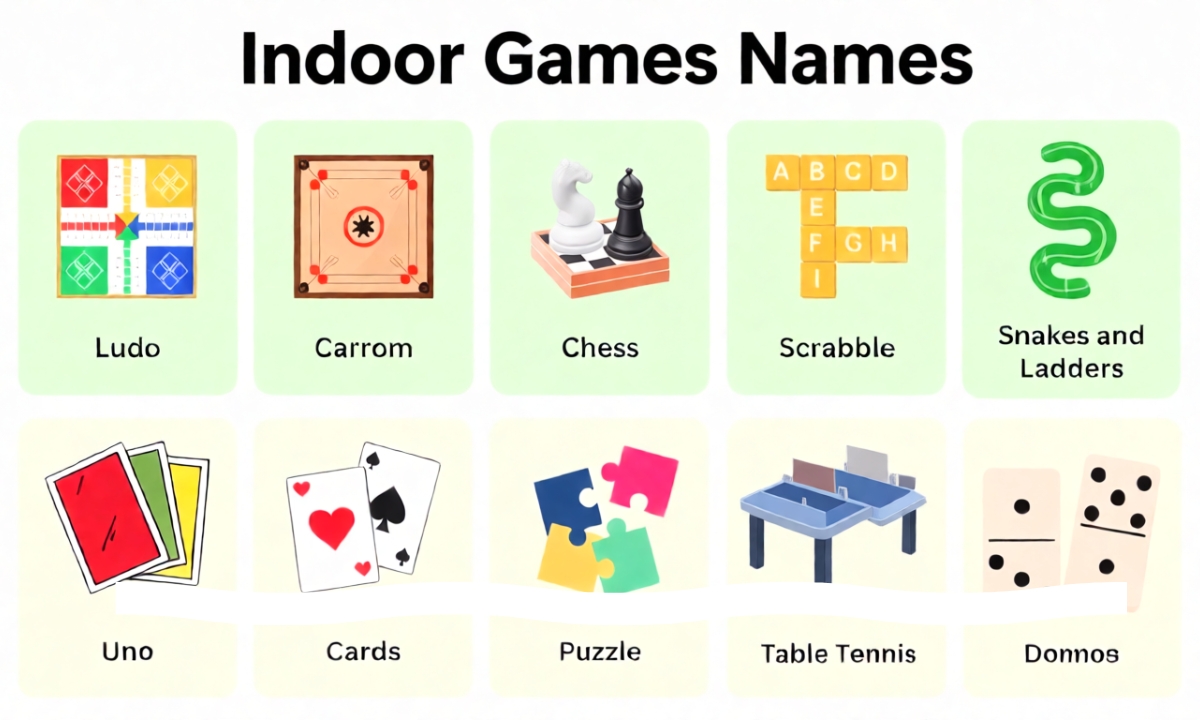
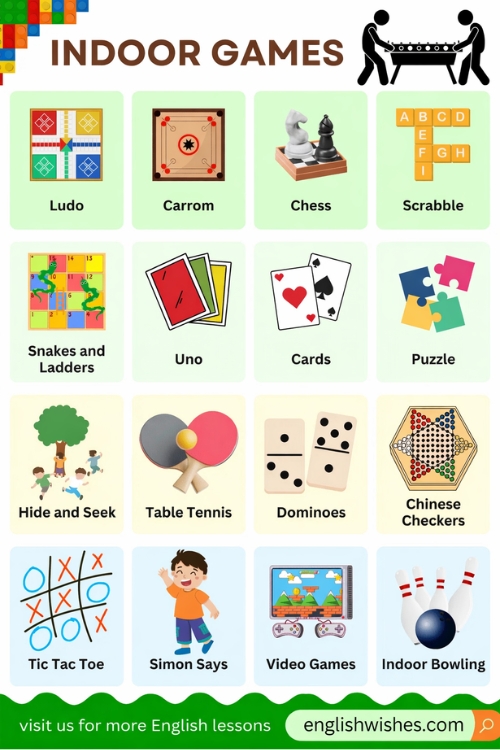
Chess: The ultimate strategy game with black and white pieces. Players move different pieces across 64 squares strategically. The goal involves capturing the opponent’s king piece. Chess improves logical thinking and long-term planning abilities. This ancient game remains popular across all cultures worldwide.
Ludo: A colorful board game perfect for family gatherings. Players race their tokens from start to finish positions. Dice rolls determine movement around the board path. Simple rules make Ludo accessible for young children. The game teaches counting and basic probability concepts.
Carrom: A tabletop game requiring precision and control skills. Players flick a striker to pocket wooden coins. The game originated in India and spread globally. Carrom develops fine motor skills and hand-eye coordination. It offers competitive fun for players of all ages.
Table Tennis: Fast-paced racket sport played on indoor tables. Players hit lightweight balls back and forth quickly. Quick reflexes and good hand-eye coordination are essential. Table tennis provides excellent cardiovascular exercise indoors. The game improves concentration and reaction time significantly.
Scrabble: Word-building game that challenges vocabulary knowledge extensively. Players create words on a grid using letter tiles. Different letters carry varying point values for scoring. Scrabble enhances spelling and strategic thinking simultaneously. The game suits language learners perfectly well.
Monopoly: Classic property trading game that simulates business operations. Players buy properties and collect rent from opponents. Strategic decisions determine financial success in the game. Monopoly teaches basic economics and negotiation skills effectively. Games can last hours with multiple players competing.
Jenga: Wooden block stacking game requiring steady hands carefully. Players remove blocks without toppling the tower structure. Each turn increases tension and difficulty progressively higher. Jenga improves focus and motor control precision noticeably. The game creates exciting suspenseful moments for everyone.
Playing Cards: Versatile deck enabling hundreds of different games. Standard decks contain 52 cards in four suits. Card games range from simple to highly complex. Playing cards develop memory and mathematical thinking naturally. They’re portable and affordable entertainment options always.
Rubik’s Cube: Colorful 3D puzzle with rotating sections uniquely. Solvers must match colors on all six faces. The cube challenges spatial reasoning and problem-solving abilities. Millions worldwide enjoy this brain-teasing puzzle regularly. Speed-solving competitions attract dedicated enthusiasts globally.
Jigsaw Puzzles: Picture puzzles with interlocking pieces for assembly. Puzzles range from simple 50-piece sets to 5000-piece challenges. Completing puzzles improves patience and attention to detail. The activity provides relaxing meditative entertainment peacefully. Puzzles suit solo or group collaborative efforts equally.
Dominoes: Rectangular tiles with numbered dots for matching. Players connect tiles with matching numbers strategically. Various domino games exist across different cultures worldwide. The game teaches number recognition and strategic planning. Dominoes offer simple yet engaging entertainment for all.
Snakes and Ladders: Traditional board game teaching life lessons playfully. Players move based on dice rolls up and down. Ladders represent good deeds climbing upward positively. Snakes symbolize mistakes sliding downward consequently. The game demonstrates chance and consequences beautifully.
Indoor Games Categories
Strategic Games:
- Chess
- Checkers
- Backgammon
- Stratego
- Risk
Action Games:
- Table Tennis
- Foosball
- Air Hockey
- Indoor Bowling
- Darts
Creative Games:
- Pictionary
- Charades
- Building Blocks
- Clay Modeling
- Origami
Educational Games:
- Scrabble
- Trivial Pursuit
- Brain Teasers
- Memory Games
- Math Bingo
Frequently Asked Questions
What is the most popular indoor game?
Chess ranks among the most played indoor games worldwide with millions of enthusiasts.
Can indoor games improve health?
Yes, many indoor games provide physical exercise and mental stimulation benefits effectively.
Are indoor games suitable for all ages?
Most indoor games can be adapted for different age groups and skill levels easily.
How many players are needed for indoor games?
Indoor games accommodate anywhere from one player to large groups depending on the game.
Do indoor games require expensive equipment?
Many indoor games need minimal investment with affordable or homemade equipment options available.
Can indoor games help children learn?
Indoor games teach valuable skills including math, language, strategy, and social interaction naturally.
What indoor games burn the most calories?
Active games like table tennis, dancing games, and indoor sports burn significant calories effectively.
Are digital indoor games beneficial?
Digital games offer entertainment and cognitive benefits but should balance with physical activities.
How do indoor games reduce stress?
Games provide mental distraction, social connection, and enjoyable activities that lower stress hormones.
Can indoor games replace outdoor activities?
Indoor games complement but shouldn’t completely replace outdoor physical activities and nature exposure.
What indoor games improve memory?
Card games, puzzles, memory matching games, and strategic board games boost memory significantly.
Are indoor games good for seniors?
Yes, indoor games keep seniors mentally active, socially engaged, and physically mobile safely.
How long should indoor game sessions last?
Sessions typically range from 15 minutes to several hours depending on interest and game complexity.
Can indoor games teach teamwork?
Many indoor games require cooperation and communication, developing excellent teamwork skills naturally.
What indoor games need no equipment?
Games like charades, storytelling, shadow puppets, and verbal games require absolutely no equipment.
Conclusion
Indoor games offer endless entertainment possibilities for everyone regardless of age or ability. These activities bring families together and create cherished memories that last lifetimes. The variety of available games ensures something perfect exists for every preference and occasion.
Playing indoor games regularly contributes to overall well-being and happiness significantly. Physical health, mental sharpness, and social connections all improve through consistent gameplay. Indoor games provide valuable learning opportunities disguised as pure entertainment and fun.
The accessibility and convenience of indoor games make them irreplaceable in modern life. Weather conditions never prevent enjoyable gaming sessions inside comfortable homes. Indoor games transform ordinary days into extraordinary adventures filled with laughter and excitement. Start exploring different indoor games today and discover new favorites for your household.

Muhammad Shoaib is a passionate content creator with 3 years of experience in Love Shayari, Sad Shayari, Birthday Shayari. He crafts engaging, heartfelt content for readers and currently contributes his expertise to Englishwishes.com, delivering inspiring and memorable shayari and blog posts for a wide audience.