Affirmative sentences help us express positive thoughts in a clear and confident way. They are simple statements that say something is true or real. Using affirmative sentences can improve communication, writing skills, and daily conversations. They are easy to understand and useful for learners of all ages. These sentences also help build confidence in spoken and written English. That is why they are important in everyday language.
This 81 Affirmative Sentences List 2026 is designed to make learning easier and more practical. Each sentence is short, clear, and human-friendly. The list supports students, teachers, and content writers alike. It helps improve grammar, sentence structure, and fluency. You can use these sentences for practice, exams, or daily use. Overall, this list makes positive sentence learning simple and effective.
What Are Affirmative Sentences?
An affirmative sentence is a statement that declares something to be true. These positive sentences in English express facts, opinions, or ideas without negation. Understanding what is an affirmative sentence is fundamental to mastering English grammar. The affirmative statement definition simply means a sentence that confirms or asserts something positively. Unlike negative sentences, affirmative sentences do not contain words like “not,” “never,” or “no.”
Affirmative sentences are one of the most important types of sentences in English. They form the backbone of everyday communication. When we talk about sentence structure in English, affirmative sentences follow a basic pattern: subject + verb + object. These declarative sentences make statements and end with a period. Students from class 5 to class 8 learn these essential grammar rules as they build their language foundation.
The affirmative sentence meaning is straightforward and clear. These sentences help us express thoughts positively. Whether you’re writing essays, speaking in conversations, or taking competitive exams, mastering affirmative sentences in English grammar is crucial. For ESL learners and beginners, practicing basic affirmative sentences daily improves fluency. Let’s explore comprehensive affirmative sentence examples to strengthen your understanding.
81 Affirmative Sentences List
Here is a detailed list of affirmative sentences covering various tenses and contexts. This English affirmative sentences list serves as an excellent resource for students, teachers, and learners.
Affirmative Sentences in Present Tense
- The sun rises in the east.
- She loves reading books.
- Children play in the park.
- Water boils at 100 degrees Celsius.
- My brother works at a bank.
- Dogs bark at strangers.
- We eat breakfast every morning.
- Birds fly in the sky.
- Students study hard for exams.
- Flowers bloom in spring.
- He drives to work daily.
- Teachers explain lessons clearly.
- Cats drink milk regularly.
- Rain falls from clouds.
- My sister sings beautifully.
Affirmative Sentences in Past Tense
- She completed her homework yesterday.
- They visited the museum last week.
- I watched a movie on Friday.
- He played football with friends.
- We traveled to London last summer.
- The dog barked loudly at night.
- Students submitted their projects on time.
- She cooked delicious dinner last evening.
- My father taught me to ride a bike.
- They enjoyed the concert thoroughly.
- I finished reading that novel.
- The team won the championship.
- Rain stopped after two hours.
- She wrote a beautiful poem.
- We celebrated his birthday together.
Affirmative Sentences in Future Tense
- I will visit my grandparents tomorrow.
- She will start her new job next month.
- They will travel to Paris next year.
- We will complete the project soon.
- He will learn Spanish next semester.
- The school will organize a cultural program.
- I will call you this evening.
- She will bake a cake for the party.
- Students will participate in the competition.
- We will watch the match tonight.
- He will buy a new car soon.
- They will move to a new house.
- I will finish this book by Monday.
- She will join the dance class.
- We will plant trees in the garden.
Simple Affirmative Sentences for Daily Use
- Good morning, everyone.
- I feel happy today.
- This coffee tastes delicious.
- My name is Sarah.
- I live in New York.
- She looks beautiful in that dress.
- The weather is pleasant today.
- I like chocolate ice cream.
- He speaks three languages fluently.
- This book is very interesting.
- My mother is a doctor.
- The cat is sleeping peacefully.
- I enjoy listening to music.
- That building is very tall.
- She has two younger brothers.
Affirmative Sentences for Students (Class 5-8)
- Mathematics is my favorite subject.
- Our teacher is very helpful.
- I completed my homework carefully.
- The library has many books.
- Science class is very exciting.
- My classmates are very friendly.
- I scored good marks in the test.
- The principal appreciated our performance.
- We have a sports day next week.
- English grammar is important for communication.
- I practice writing every day.
- The school bell rings at 8 AM.
- We learn new things daily.
- Art class develops our creativity.
- I respect my teachers and parents.
Affirmative Sentences for Spoken English
- I understand your point clearly.
- That sounds like a great idea.
- I agree with your suggestion.
- This place is absolutely amazing.
- Thank you for your help.
- I appreciate your kindness very much.
Examples of Simple Affirmative Sentences
Simple affirmative sentences are easy to construct and understand. These basic affirmative sentences follow straightforward grammar rules. Let’s examine some affirmative sentence examples with detailed explanations.
“She writes poetry” is a perfect example of an affirmative sentence. The subject is “she,” the verb is “writes,” and the object is “poetry.” This sentence structure in English is clear and direct. Another example: “They enjoy dancing” shows an affirmative statement definition in action. For affirmative sentences for kids and beginners, starting with simple present tense works best.
Consider these 10 examples of affirmative sentences for practice: The dog runs fast. I drink water daily. He reads newspapers. She paints pictures. We love nature. Children laugh happily. Birds sing melodiously. Teachers inspire students. Books provide knowledge. Friends support each other. These affirmative sentences for ESL learners demonstrate basic sentence construction effectively.
| Tense | Affirmative Sentence Example | Structure |
| Present Simple | She teaches English | Subject + Verb + Object |
| Past Simple | He visited the zoo | Subject + Verb (past) + Object |
| Future Simple | I will attend the meeting | Subject + will + Verb + Object |
| Present Continuous | They are playing cricket | Subject + am/is/are + Verb-ing |
| Past Continuous | She was reading a book | Subject + was/were + Verb-ing |
Importance of Affirmative Sentences
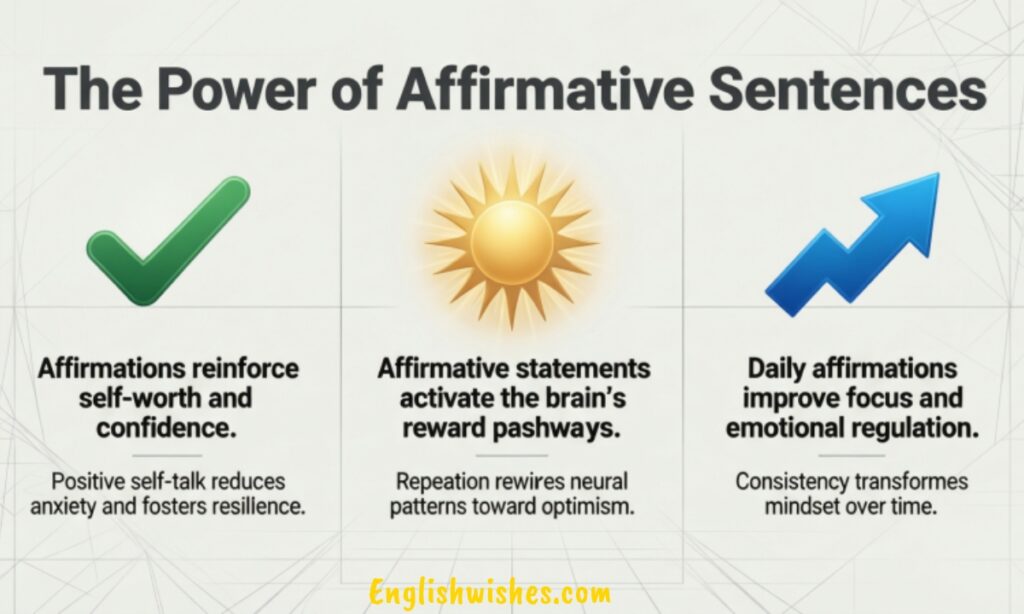
Affirmative sentences form the foundation of effective communication. Understanding affirmative sentences rules helps students excel in English grammar. These positive sentences convey information, share experiences, and express opinions clearly. For competitive exams, mastering affirmative sentence examples for exams is essential.
In daily conversation, we use affirmative sentences in spoken English constantly. From greeting someone to sharing news, affirmative statements dominate our speech. Students learning affirmative sentences for class 5, class 6, class 7, and class 8 build strong grammatical foundations. Teachers use affirmative sentences worksheet materials and affirmative sentences exercises to help students practice regularly.
The difference between affirmative vs negative sentences is significant. While negative sentences deny or refuse, affirmative sentences confirm and assert. Similarly, affirmative and interrogative sentences serve different purposes. Interrogative sentences ask questions, while affirmative sentences make statements. This affirmative sentences explanation simply helps learners understand sentence types better.
Benefits of Learning Affirmative Sentences:
- Improves clarity in communication
- Builds confidence in speaking English
- Essential for writing skills development
- Helps in understanding sentence structure
- Necessary for grammar proficiency
- Useful in professional and academic settings
- Enhances overall language comprehension
Common Mistakes with Affirmative Sentences
Students often make errors when constructing affirmative sentences. Learning from these mistakes improves grammar skills significantly. Here are common errors with affirmative sentences for beginners and how to avoid them.
Subject-Verb Agreement Errors: Many students write “She go to school” instead of “She goes to school.” The verb must agree with the subject in number and person. This is crucial in affirmative sentences in English grammar. Another mistake is writing “They was happy” instead of “They were happy.” Proper verb forms matter in affirmative sentences for students.
Incorrect Word Order: Some learners place words incorrectly, writing “Yesterday I went not to school” instead of properly structuring negative sentences. Remember, affirmative sentences maintain standard word order: subject + verb + object. This affirmative sentences grammar rules principle is fundamental.
Mixing Tenses: Students sometimes mix tenses within a sentence. “Yesterday, she goes to the market” is incorrect. The correct affirmative sentence should be “Yesterday, she went to the market.” Understanding affirmative sentences in present tense, affirmative sentences in past tense, and affirmative sentences in future tense helps avoid this error.
| Incorrect Sentence | Correct Sentence | Mistake Type |
| He don’t like pizza | He doesn’t like pizza | Subject-verb agreement |
| She are my friend | She is my friend | Incorrect verb form |
| They goes shopping | They go shopping | Subject-verb agreement |
| Yesterday I eat lunch | Yesterday I ate lunch | Wrong tense |
| Beautiful the flower is | The flower is beautiful | Word order |
Overcomplicating Sentences: Beginners sometimes create unnecessarily complex structures. Simple affirmative sentences work best for clear communication. Practice with affirmative sentences for practice materials, affirmative sentences chart references, and affirmative sentences notes improves accuracy.
Forgetting Articles: Writing “She is teacher” instead of “She is a teacher” is common. Articles are essential in English sentence structure. Reviewing affirmative sentences with examples helps recognize these patterns. Using affirmative sentences pdf resources and affirmative sentences with answers provides structured learning opportunities.
For effective learning, students should complete affirmative sentences exercises regularly. Taking an affirmative sentences quiz tests understanding. Teachers can provide affirmative sentences for writing and affirmative sentences for speaking practice to reinforce learning comprehensively.
Frequently Asked Questions
What is an affirmative sentence?
An affirmative sentence is a positive statement that declares something to be true without any negation words.
How do affirmative sentences differ from negative sentences?
Affirmative sentences state facts positively, while negative sentences deny or refuse using words like “not” or “never.”
What are some affirmative sentence examples?
Common examples include “The sun shines brightly,” “She loves reading,” and “They play football.”
Can affirmative sentences be questions?
No, affirmative sentences are statements, not questions. Questions are interrogative sentences with different structures.
How do I teach affirmative sentences to kids?
Start with simple present tense examples, use visual aids, practice with worksheets, and provide daily conversation examples.
What is the structure of affirmative sentences?
The basic structure follows: Subject + Verb + Object, though this can vary with sentence complexity.
Are declarative sentences the same as affirmative sentences?
Declarative sentences make statements and include both affirmative and negative sentences. Affirmative sentences are positive declarative sentences.
Why are affirmative sentences important for students?
They form the foundation of English grammar, improve communication skills, and are essential for academic and professional success.
How can I practice affirmative sentences effectively?
Use worksheets, complete exercises, read English books, practice speaking daily, and review grammar rules regularly.
What are common mistakes with affirmative sentences?
Subject-verb agreement errors, incorrect word order, tense mixing, and forgetting articles are typical mistakes.
Conclusion
Affirmative sentences are essential building blocks of English communication. This comprehensive guide with 81 affirmative sentences list provides valuable resources for learners at all levels. From understanding what is an affirmative sentence to practicing affirmative sentence examples, we’ve covered everything students need.
Whether you’re studying affirmative sentences for class 5, class 6, class 7, or class 8, consistent practice improves proficiency. Use affirmative sentences worksheet materials, complete affirmative sentences exercises, and take affirmative sentences quiz assessments regularly. Understanding affirmative sentences in present tense, affirmative sentences in past tense, and affirmative sentences in future tense strengthens your grammar foundation.
Remember the difference between affirmative vs negative sentences and affirmative and interrogative sentences. These positive sentences in English express ideas clearly and confidently. For ESL learners, affirmative sentences for beginners provide excellent starting points. Students preparing for competitive exams benefit from reviewing affirmative sentence examples for exams and practicing with affirmative sentences for competitive exams materials.
Master these sentence structure in English patterns through daily practice. Use this list of affirmative sentences, study affirmative sentences with answers, and refer to affirmative sentences pdf resources. Whether for affirmative sentences for writing, affirmative sentences for speaking, or understanding affirmative sentences definition and examples, consistent effort yields excellent results. Keep practicing these basic affirmative sentences, and your English grammar skills will improve significantly.

Muhammad Shoaib is a passionate content creator with 3 years of experience in Love Shayari, Sad Shayari, Birthday Shayari. He crafts engaging, heartfelt content for readers and currently contributes his expertise to Englishwishes.com, delivering inspiring and memorable shayari and blog posts for a wide audience.